Bengt Lindström
Bengt Lindström
Scroll down
Bengt Karl Erik Lindström was born on 3 September 1925 in Storsjö kapell, in the Härjedalen region of northern Sweden.
His childhood unfolded in an environment deeply marked by the harsh nature of Swedish Lapland and by the cultural traditions of the Sami, the indigenous people of Scandinavia. This intimate bond with the natural world and with the mythical imagination of northern Europe would go on to shape his artistic work decisively throughout his life.
In 1944, Lindström began his artistic training in Stockholm, where he studied with the modernist painter Isaac Grünewald. He later continued his studies in Copenhagen under the guidance of Aksel Jørgensen, and in 1946 he attended the Art Institute of Chicago, where he came into contact with North American abstract expressionism, in particular with the work of Jackson Pollock and Willem de Kooning. The following year he settled in Paris, where he refined his practice under masters such as Fernand Léger and André Lhote, consolidating a visual language of his own, rooted in the expressiveness of form and the intensity of colour.
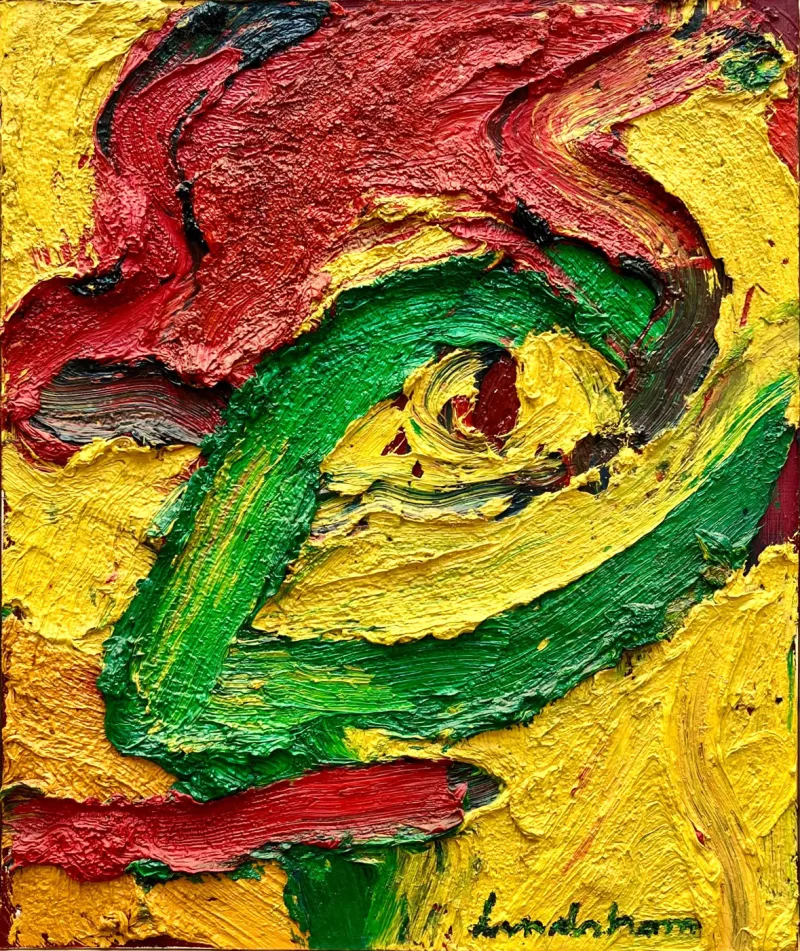
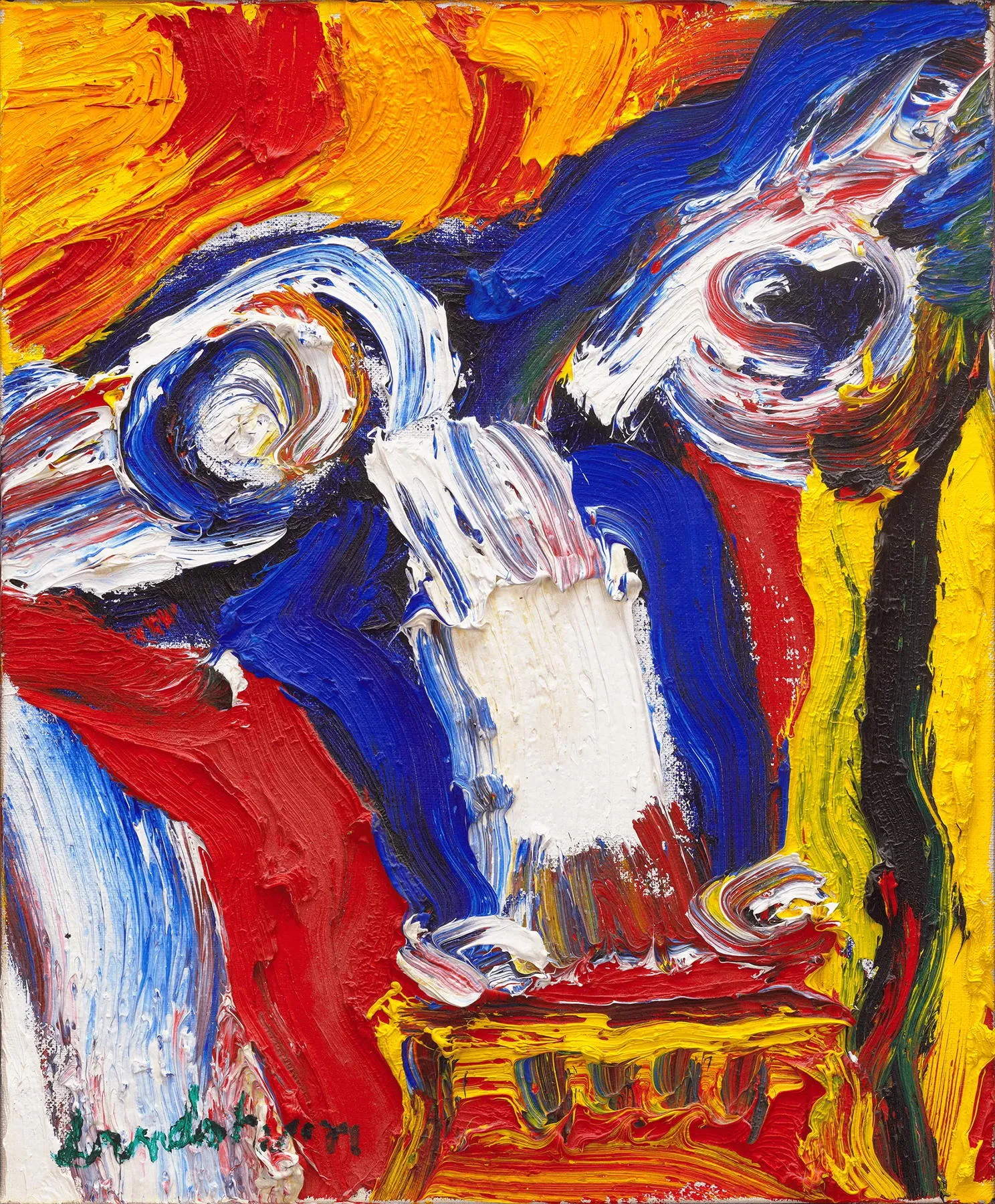
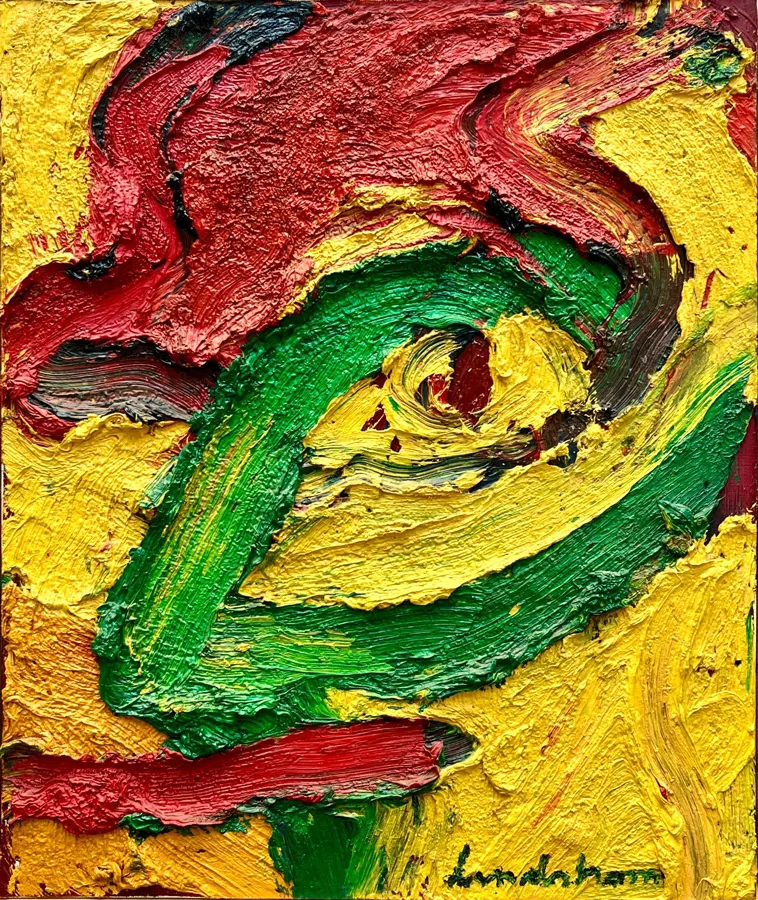
Lindström's work is characterised by the vigorous use of primary colours, dense brushstrokes and distorted figures, evoking masks, mythical creatures and Norse gods. His technique is notably gestural, often applying thick paint with his fingers or with broad brushes, in a visceral, material approach. He worked across a range of media, including painting, lithography, ceramics, tapestry, sculpture in paper and papier mâché, and monumental interventions in public spaces.
His artistic career began with solo exhibitions in Sweden in the 1950s, soon reaching international prominence. He took part in important avant-garde group shows, notably those linked to the COBRA movement, which shared with Lindström a commitment to spontaneity and to the primitive force of art.
From the 1960s onwards, he exhibited regularly in cities such as Paris, London, Tokyo, Brussels and Pittsburgh. In 1983 he presented the series “The Great Aesir Gods”, made up of seven large canvases devoted to Norse mythology, at the Museu de Arte e História de Estocolmo.
Alongside his studio production, Lindström made large-scale public works, among them murals, mosaics and monumental sculptures installed in various urban spaces in Sweden, such as the celebrated sculpture “Y” at Midlanda Airport, as well as interventions in railway stations, universities and public infrastructure. His work is represented in a number of prestigious collections, including the Moderna Museet (Stockholm), the Musée d'Art Moderne de Paris, the Centre Pompidou, the Louisiana Museum (Denmark), Tate (London) and the Carnegie Museum of Art (Pittsburgh).
In 2003 a stroke brought his artistic activity to an end. The following year saw the release of the documentary Lindström: Le Diable de la Couleur et de la Forme, which explores his career and his singular vision of painting. Bengt Lindström died on 29 January 2008 in Sundsvall, leaving an artistic legacy profoundly marked by colour, expressive energy and the mythology of the North.